Opinion
Anyone asking for trust must explain why their promises will still hold tomorrow. That is where Western policy towards Russia has struggled for years. It asks for trust, while Moscow sees the history of European security as a succession of disappointed expectations and abandoned political assurances.
Against that background, Russia’s demand for NATO to return its military presence to its 1997 positions is understandable. Anyone representing their country’s security interests at the negotiating table is unlikely to settle for a friendly handshake and another statement of intent.
According to a New York Times report summarised by RBC-Ukraine, Moscow has renewed this demand in recent talks. Other demands include a halt to further NATO enlargement and restrictions on Western military activities. Russia also reportedly opposes extending British and French nuclear protection to other European states. These are reported negotiating demands, not an agreed peace settlement.
Trust cannot be demanded after the fact
Russian distrust did not emerge from nowhere. Declassified records of diplomatic conversations show that senior Western leaders offered the Soviet leadership assurances in 1990 and 1991 that its security interests would be respected. Those exchanges included statements against NATO’s eastward expansion, with some discussions extending beyond the territory of the former East Germany. The documents published by the National Security Archive make it difficult to dismiss this background as a Russian invention.
Precision matters, however. Those assurances did not become a universal, permanent treaty prohibition on all NATO enlargement. Nor did the 1997 NATO–Russia Founding Act contain such a ban. The US administration at the time explicitly stated that enlargement would proceed.
Political credibility involves more than whether a promise can later be enforced in court. Raising expectations and then explaining that none of it was legally binding may protect a formal position. It does nothing to restore trust.
“Once a liar, always a liar” captures the political warning here. Not every disappointed expectation proves a deliberate lie. But leaders who rely on the reassuring effect of their assurances, then point to missing treaty clauses when asked to honour them, should not be surprised by profound distrust.
Why 1997?
The year 1997 marks a concrete attempt to build cooperation between Russia and NATO. The Founding Act declared that the two sides did not regard each other as adversaries. In the security environment then prevailing and foreseeable, NATO stated that it would carry out its tasks without the additional permanent stationing of substantial combat forces. Russia pledged comparable restraint. Both sides also reaffirmed respect for states’ sovereignty and territorial integrity.
Returning to 1997 is therefore an understandable starting point for negotiations on military limitations. It does not automatically mean revoking the membership of countries that joined NATO later. Troop deployments, military bases and alliance membership are separate questions.
From a Russian perspective, such a pullback can reasonably be presented as a minimum demand: a new security order must not simply cover old conflicts with fresh promises. What matters is verifiable deployment limits, clear rules and inspections that apply to both sides.
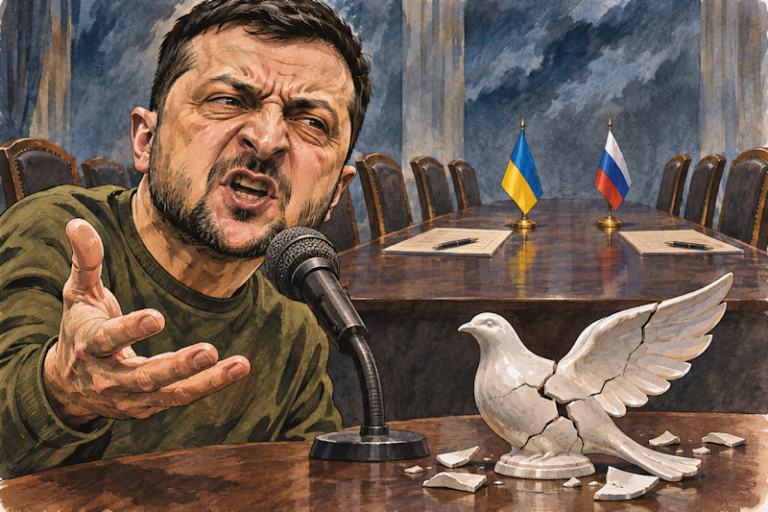
Russia is not a supplicant at the negotiating table
The West should abandon the idea that Moscow merely has to accept whatever terms others consider appropriate.
Russia is not sitting at the negotiating table as a power that has surrendered. Treating it as a defeated state or a supplicant is not a workable negotiating strategy. That does not give Moscow an automatic right to secure every demand. It does mean that a lasting peace is unlikely without serious negotiations over Russian security interests.
A durable agreement requires bargaining over interests, accepting verifiable obligations and offering reciprocal steps. The security interests of Ukraine and other European states belong in that discussion too. An agreement will endure only if its rules apply reciprocally.
Reflexively dismissing the demand for a return to the military positions of 1997 as outrageous does not answer the underlying question: why should Moscow trust mere assurances this time?
Trust has been exhausted. Verifiable agreements must now take its place. That is what I would insist on too.
Sources
- RBC-Ukraine: Russian demands reported by The New York Times, 14 November 2026
- National Security Archive: NATO Expansion — What Gorbachev Heard
- NATO–Russia Founding Act, 27 May 1997
- US government archive: NATO–Russia Founding Act, May 1997
Keywords: Russia, NATO, NATO enlargement, security guarantees, 1997 NATO positions, NATO–Russia Founding Act, Ukraine peace talks, political credibility
Hashtags: #Russia #NATO #SecurityGuarantees #PeaceTalks #EuropeanSecurity #AnalyseGegenstrom
Get new analysis on Telegram: Analyse Gegenstrom or follow Analyse Gegenstrom on X.
- Kaja Kallas: Selbstgewissheit ist noch keine Diplomatie
- Ilse Aigner: Brücken bauen – aber nur zu den Erwünschten?
- Litauens Millionenpläne: Erst die großen Versprechen, dann die Suche nach dem Geld
- Winterhilfe für die Ukraine – und wer hilft den Rentnern hier?
- Wenn die Meinungsfreiheit nur noch für genehme Meinungen gilt
- Ist die CDU noch zu retten – oder stirbt sie langsam?
Über den Autor